poetry

His Purpose is My Hope

I am so alone
unable to speak with words, only groans.
I see the looks;
hear the whispers…

I turn to the left and sense the sighs. I hear the unsaid words,
“If only you had done this, or done that…”
I turn to the right only to see other parents pull their children away in fear
just in case it is infectious.

I look behind and see their looks of pity.
They know I see it but they choose to be aloof.
Yet I also sense fear in their eyes, “If it happened to them, will it happen to me?”

Blue eyes, brown eyes… ooze with thick, black condemnation
eyebrows raised, lips pursed.
Tsk, tsk…
Chiding me with every breath.

I turn around. Momentarily relieved to have found a place of rest.
Of peace,
an absence of condemnation or self righteousness…
But it is an illusion. Not real. It’s there, veiled behind music and smiles, preaching, prayers and Bible verses.

I soon learn and accept that all is not as it seems
This place – is filled with dark hopelessness and resignation
“Oh well, what can ya do?” and “Kids will be kids” and other such empty, throwaway lines…

I look forward…
look straight ahead…
to The One who knows and see all,
who is not bound by the earthly constraints of time and physicality.

I see hope.
He has her,
in His hands,
He will call her in his time.

This One.
He knows me,
knows what I have done,
where I have tried and failed.

Everything is in His hands,
not mine.
He has His purpose,
As if I could stop it.

No more control,
or shame,
or guilt
when I abide in Him and Him alone.

You are who you are for a reason….

baby-in-womb-sucking-thumbs600x600This poem really touches me…means a lot to know that I am not an accident and that God has a purpose for my life.

You are who you are for a reason….
by Russell Kelfer

You are who you are for a reason.
You’re part of an intricate plan.
You’re a precious and perfect unique design,
Called God’s special woman or man.

You look like you look for a reason.
Our God made no mistake.
He knit you together within the womb.
You’re just what He wanted to make.

The parents you had were the ones He chose,
And no matter how you may feel,
They were custom-designed with God’s plan in mind,
And they bear the Master’s seal.

No, that trauma you faced was not easy.
And God wept that it hurt you so;
But it was allowed to shape your heart
So that into His likeness you’d grow.

You are who you are for a reason,
You’ve been formed by the Master’s rod.
You are who you are, beloved,
Because there is a God!

Russell Kelfer (1933-2000) was an elder and Bible teacher at Wayside Chapel in San Antonio, Texas for more than 20 years. During his life time he was active in a broad variety of Christian projects ranging from education to a World’s Fair pavilion. His legacy of practical application Bible studies, poems, and fictional stories know no denominational boundaries.

Poetry using the Observation and Activity Sheets

Inkster_Definition_Observer

The past few posts have outlined how we gently and naturally enjoy poetry and learn about a variety of topics through it. Sometimes I might ask the boys to fill out a 5W and H sheet but usually it is just an informal process involving discussion. Below are some of the 5W’s and a H we’ve discussed, while enjoying The Man from Snowy River, using the 5W’s and a H Observation sheet, which you can download from the downloads page.

  • Who wrote the poem?
  • What can you tell me about A.B. Paterson?
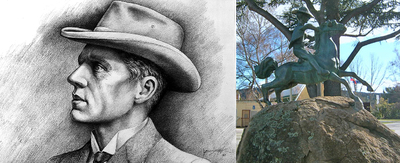
  • On which Australian banknote would you find a picture of Mr. Paterson?
  • Do you know when this poem was written?
  • When do you think this even took place in Australia’s timeline?
  • Who is major character or who is the poem referring to?
  • What other people are mentioned?
  • What is the main event or events?
  • Tell me what you know about the bushmen. Describe them.
  • Where did this event take place? Describe the location and surroundings.
  • Along with the Poet Biographical Outline, I have the boys choose one or more activities from the Activity Sheets (also available from the downloads page) to complete.

I’ve found that using the Observation Sheet is a key element in the art of narration. Whilst the girls seemed to be able to narrate for days on end, the Observation Sheet has been invaluable for the boys. It helps them to look for the main points in a story, poem or movie. Whilst I certainly don’t like to reduce any art form or literary medium to a basic ‘who-why-what-when-where’ format, it is helpful for those who find a rich, literary style rather superfluous.

😉

Learning about the Man from Snowy River

I am not good at writing poetry. I don’t understand a lot of it yet I want to instill an appreciation and basic knowledge of poetry to my children. That is my goal or the *where*. Knowing the ‘where’ dictates how we do poetry appreciation. Other families are different. Some don’t do it at all and others do it very indepth. Keeping the goal in my mind helps me to maintain a light, enjoyable atmosphere in the home. While we’re doing poetry appreciation though, we may as well multi task.

This very simple, time-efficient, gentle and enjoyable activity teaches us how to use beautiful words and how to use words beautifully. The recitation/speaking aloud part is the very beginnings of public speaking. I encourage the children to speak clearly and enunciate carefully. Copywork provides opportunity for handwriting, spelling, poetry structure, and word usage. Memorisation helps to build strong, healthy mental muscles. Learning research skills whilst completing the Author Bio sheet is another worthwhile activity.

banjo-paterson

Yesterday I wrote about our enjoyment in reading The Man from Snowy River. Today I’d like to share a little more of how we learn through poetry.

We also look at a map of Australia to see whereabouts this poem is taking place. The Snowy Mountains. We have a look at the Snowy Mountains website. I show them the page about the Snowy Hydro’s hydroelectric power stations and we talk about this, for their grandfather (Hi Pop!) worked there as a cook, while it was being constructed.

We look at an Australian $10 note. If you look very closely you will see a likeness of Banjo Paterson…and using a magnifying glass you can even see, in very fine print, the opening stanza from the poem!
“There was movement at the station for the word had passed around…”

I may also strew some art books or pictures, if I have any that depict the location or similar scenery. It adds to our theme but is not necessary. I used to try and make a full blown mini unit study and connect all the dots for the children: explaining how everything was connected together. Now I don’t. I prefer more natural means like strewing. I now know that the children are more than capable of making their own connections and, in fact, when they do so, are more excited about it than when I attempt to spoon feed them with information.

During one morning tea session we got so carried away with reading Banjo Paterson’s poetry that we also read “Clancy of the Overflow” as Clancy is mentioned in Man from Snowy River. During yet another morning, I ask the children to tell me, in their own words, what the whole poem is about, and what their favourite part or line is. I’m not just looking for sentences like, “oh, I like it. It is good”. I have our Observation Sheet printed out and on the wall so we can refer to it often. I want to know Who, Why, What, Where, When and How of the poem.

For those that don’t know of the poem, you can read it here and you can listen to Jack Thomson reciting a snippet here. (#14) But even better is the free pdf download of a whole Banjo Paterson ebook, courtesy of the University of Sydney.

I might leave a copy of The Silver Brumby by Elyne Mitchell lying around the place. One just never know, it might capture one’s interest! The other thing I do, at first without the childrens knowledge, is to play music from the Man from Snowy River music throughout the day. Jessica’s Theme is a gorgeous piece of music, written by Bruce Rowland. You can listen to snippet of it here #4. I used to play this on the piano when I was a lot younger. John and I love it so much that we had it playing in the background of our wedding video tape.  Just as much as we can strew books, article, artwork, etc I think that we can strew music as well.

This may all sound like a lot, just for one poem. However, it is naturally how I learn and investigate things that I’m interested in…so it is natural that this is how I would present material to my children. It’s not hard or overly indepth. Everything is fairly accessible,, especially in this day and age of the Internet.

Tomorrow, I’ll write how we tie it together using our Activity  and Observation Sheets.

Current poetry appreciation in our home

banjo-paterson

We’re appreciating The Man from Snowy River by A.B. (Banjo) Paterson. This is the second time through this piece of poetry as we went through it with the girls…and now I get to indulge again with the boys.

🙂

Poetry appreciation is a very gentle affair in our household. I thought I’d share what we do and how we do it. I used to try and connect all the dots for my children and we’d almost do a mini unit study on the poem and poet but I simply lack the energy needed to do this anymore.I realise this poem is fairly lengthy but I sensed the boys would be up for it. hey, they’re boys. They love a challenge!

😀

Over a hot chocolate I ask the boys if they remembered reading this poem many years ago. Nope! They’d forgotten. (I nod my head in an effort to hide the sigh) I ask if they remembered watching the movies, of which we own the classic editions because it is such a *family* favourite. Ha! Nope! They didn’t remember that either. Oi voi, what am I doing? While trying not to choke on my cappuccino I gently explain that we are going to look at this piece of work for a few weeks. Hmm, I was met with quizzical looks. A few weeks on one poem?

In between sips of cappuccino I simply read it aloud.

Then I explain that after a few weeks, I’d like each boy to be able to recite the poem aloud. Oh, now they’re showing signs of interest- or do they realise that they will be very embarrassed if they don’t put in some effort?

I read the first stanza aloud again. And then I went through it line by line, explaining a few (not all unknown words though. I want to keep a little bit of mystery and challenge) words and terms that they didn’t know. Ah, now a bit more interest is being shown.

I asked each boy to have a go at reading the first stanza out loud. For the zillionth time I explain how to project one’s voice, which is different to yelling. Hmm, it would be fair to say that they struggle through the first reading. Nevertheless I offer encouragement and tell them that next time they read it will be easier.  And it is.

The next day I read the first two stanza’s aloud. Now, it’s their turn. They breeze through the first stanza and fumbled a little with the second. This is quite typical. By the third day, they read the first two stanza’s beautifully…little by little.

The boys write out one stanza each day (cough cough: when we get around to it) for copywork. They learn about the structure of the poem, spelling, rhythm and new terms.

:coffee: Another day, another hot chocolate. :coffee: (Hmmm, there’s a theme here, revolving around coffee n chocolate) I read the poem out loud again, because we just enjoy it so much! But this time I pause at certain places and expect them to jump in with the rest of it. Sure enough, they do. The words in brackets are the words I’d pause at and the boys would jump in, excitedly.

E.g:

There was [Harrison,] who made his pile when [Pardon won the cup,]
The old man with his [hair as white as snow;]
But [few could ride beside him] when his blood was [fairly up -]
He would go wherever [horse and man] could go.

The next reading this won’t work as well as they will be able to recite the poem from memory. Sometimes I will just read the first word of the line out – that’s enough to jog their memory. It’s fun. The boys get to jump up and down and shout out. What’s not to like if you’re a boy?

sepretor_hr

Next week sometime, we will nestle down with blankets and chocolate and watch the movie…again. 🙂 Oh, the things a homeschool mama must do eh?

Also, in the near future I will have them do a biographical outline of the author. We’ll use a standard sheet similar to the Author Outline that can be found in my download section. Tomorrow I’ll share on other ways that I multi task using poetry. (Okay, some might call it cross curricula activities but I call it multi tasking- makes me feel efficient). There are so many wonderful ideas and ways to approach poetry, but for me, many of those ideas are simply overwhelming. The way we approach it has evolved over the years: now being gentle and natural…as natural as it can be considering that I’m not overly well educated in this area. However, I can still try to cultivate a love, or at least an appreciation of poetry.

Are you reading or enjoying any poems at the moment? Which ones? I’d love to hear about it.

Just Let Go

This poem sums up ‘letting go lessons’ that I’ve learned over the years. I’m sure though, that my time of lesson learning is not behind me…I still have some ways to go yet.

To ‘let go” does not mean to stop caring;
it means to accept that I can’t do it for someone else.
To ‘let go” is not to cut myself off;
it is the realization I can’t control another.
To ‘let go” is not to enable,
but to allow learning from the natural consequences of the choices we make.
To ‘let go” is to acknowledge that which I cannot change and
to pursue that which I can.
To ‘let go” is to admit powerlessness,
which means the outcome is out of my hands.
To ‘let go” is not to try to change or blame another;
it is to make the most of myself.
To ‘let go” is not to care for but to care about.
To ‘let go” is not to fix but to be supportive.
To ‘let go” is not to judge
but to allow another to be a human being.
To ‘let go” is not to be in the middle arranging all the outcomes
but to allow other to effect their own destinies.
To ‘let go” is not to be protective;
it is to permit another to face reality.
To ‘let go” is not to deny but to accept.
To ‘let go” is not to nag, scold or argue,
but instead to search out my own shortcomings and to correct them.
To ‘let go” is not to adjust everything to my own desires
but to take each day as it comes and to cherish myself in it.
To ‘let go” is not to criticize and regulate anybody
but to try to become what I dream I can be.
To ‘let go” is not regret the past nor fear the future
but to grow and live in the present.
To ‘let go” is to forgive, not to condone.
To ‘let go” is to free myself of my collection of past hurts and resentments.
To ‘let go” is to fear less and to love more.

Anonymous

Appreciating Poetry

I didn’t grow up with a love of poetry…and to be perfectly honest I still don’t fully appreciate poetry, mainly because I don’t fully understand it. Nevertheless, I try to foster a love and appreciation of poetry in the hearts of my children as much of the Bible is poetical so I want them to desire to read these areas and not shy away from them.

courtesy of Diane Romanello

A few years ago, we started doing poetry appreciation using Charlotte Mason’s methods, which is to study one poet per term. I found that by reading all the poems aloud together over morning tea was enjoyable and enriching but this practice also depended upon me to do the work and as my girls got older I wanted them to be more independent so I started adding the poetry to their schedule but it never seemed to get done. Maybe this is because it is small and bite-sized that they’d leave it till later…but it didn’t get read at a rate that I was happy with. I think that every child should have heard the poetry of R.L. Stevenson and A.A. Milne.

Then, I printed out the *should-read* poetry list from Ambleside Online. The girls were supposed to read a poem a day (or so). I also requested that once a term they completed a Poet Biographical Sketch and one Poem Synopsis. (‘R’ didn’t complete all this yet she still likes and appreciates poetry)

poetrybookDo you ever get that feeling that you’re running out of time? Well, as silly as it is, I feel that way too at times. I found a good book called the The Walker Book of Classic Poetry and Poets. This book has a short biographical sketch on each poet and has a few notes on each selected poem, which I found very helpful in simply giving it to ‘Miss A’ and telling her to slowly work her way through it.

I also select and read aloud poetry that fits in with our learning whether it be a unit on ‘whales’, ‘Summer’, “Easter’, ‘flowers’, ‘family’, ‘Bilbo’s Song’ or an historical time period. We read Australian poets too- who doesn’t like A.B. Paterson? I have many pages printed and filed in binders and much poetry is included so that the children can freely choose to write for copywork. If I have selected poetry to go along with our theme, they will usually do that for copy work. I also might read these poems aloud a few times before asking the children to have a go and reading it aloud, teaching them to read with character and inflection.

We have also done a unit of work on poetry. Sometimes this has come up in their LLATL books and other times, I’ve devised a mini unit on it. What this means is that we work on a few poems for copy work and dictation, while discussing the structure and language of the poem. I have bought a few books of poetry which I will strew around the home. Occasionally, I will sit in the lounge room and read a few poems myself and if one takes my fancy I will share it with the children. There are some good downloadables from CurrClick

My oldest child is now starting to read Christian poetry and enjoys the Psalms more also. I used to struggle with reading the Psalms and thought they were a bit boring…but in the last 10 years, since I’ve been stimulating my literary appetite with more poetry, I find that I enjoy and relate to the Psalms more.

My goal is not that the children should know every major poet or every classic poem, rather that they have a love for the literary language and appreciate the rich beauty of imagery presented in the poems…that they would become accustomed to reading in this way and that this may lead to a desire and joy in reading the very best forms of literature.

I have tried to accomplish this goal by learning to appreciate poetry for myself…and by not making it a ‘subject’ that needs to be ticked off until the student is older. I don’t think it really matters how you read poetry…just enjoy it!